Psoriasis plaques don't tolerate guesswork, and neither does sun protection when the goal is calming flare-ups instead of triggering new ones in 2026. This guide breaks down what actually matters in a mineral sunscreen for psoriasis flare ups and where Rejûvaskin fits the routine.
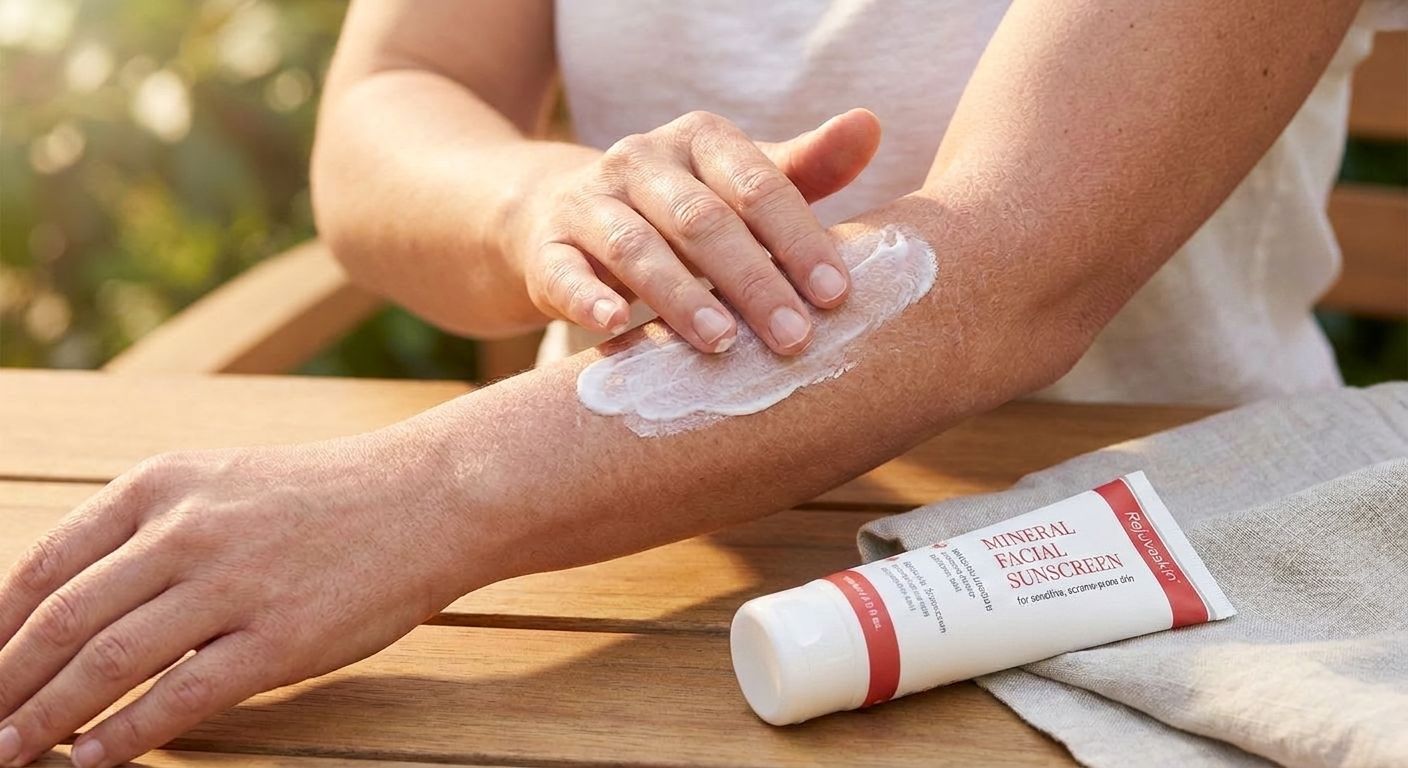
- Rejûvaskin Mineral Facial Sunscreen SPF 32 uses non-nano zinc oxide and skips fragrance, a combination that matters for psoriasis-prone skin in 2026 — Buy.
- Chemical UV filters like oxybenzone and avobenzone are common flare triggers on inflamed plaques — Skip them.
- Broad-spectrum SPF 30 or higher, reapplied every 2 hours, is the baseline dermatology guideline for daily photoprotection.
- Aerosol spray sunscreens dry unevenly on scaly plaques and are a poor fit for psoriasis-prone skin — Skip.
Why this matters
UV exposure on active psoriasis plaques does two things at once: it can suppress inflammation in small, controlled doses (the logic behind UVB phototherapy), and it can also trigger the Koebner phenomenon, where new lesions form at sites of skin trauma or irritation. Sunburn counts as trauma. Fragrance, alcohol denat, and certain chemical UV filters count as irritation.
That's the tension anyone managing psoriasis flare-ups has to navigate with sunscreen in 2026: skip photoprotection and risk sunburn-triggered flares, or use the wrong formula and risk irritant-triggered flares. A best moisturizer for psoriasis-prone skin routine paired with a clean mineral formula closes that gap without adding new triggers.
Who this is for
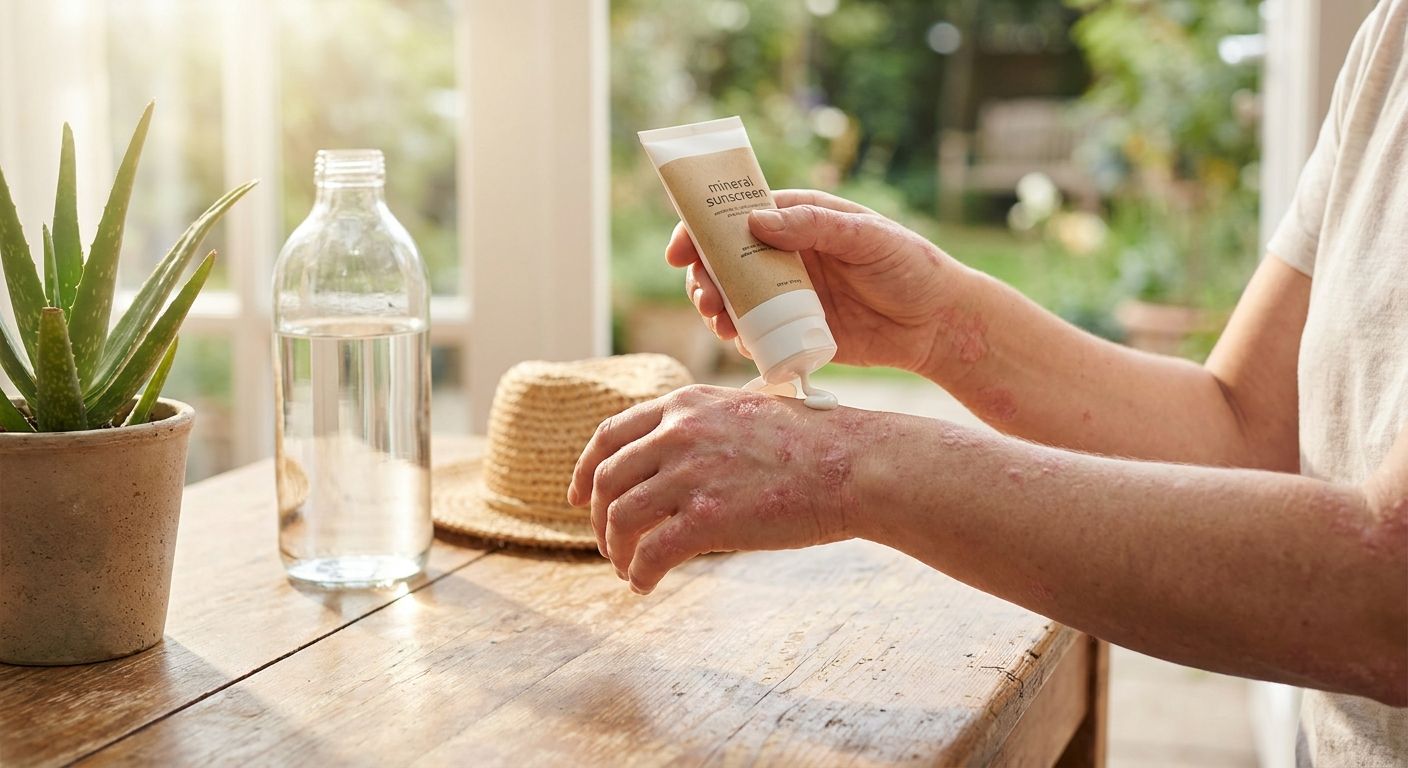
This guide is for anyone managing plaque, guttate, or inverse psoriasis who needs daily sun protection on the face, scalp margin, or exposed limbs without setting off a flare. It's also relevant if you're on biologics or topical steroids, both of which can increase photosensitivity, or if you're recovering from phototherapy sessions and need to protect treated skin between visits. The Rejûvaskin Mineral Facial Sunscreen was built around exactly this kind of sensitized, reactive skin profile.
What to look for in mineral sunscreen for psoriasis-prone skin
Non-nano zinc oxide as the sole active
Zinc oxide sits on top of the skin and reflects UV rather than absorbing into it, which matters when the skin barrier over a plaque is already compromised. Non-nano particle size keeps the mineral from penetrating broken or thinned skin, a real concern with active psoriasis lesions.
Fragrance-free and dye-free formulation
Fragrance is one of the most commonly reported contact irritants in psoriasis flare data from dermatology clinics, and it adds nothing to UV protection. A fragrance-free, dye-free base removes an entire category of unnecessary risk from a product you're applying daily.
Broad-spectrum SPF 30 or higher
The American Academy of Dermatology's standing recommendation is broad-spectrum SPF 30 or higher, reapplied every 2 hours during sun exposure. Anything lower leaves UVA exposure unmanaged, and UVA is the wavelength most linked to long-term skin damage on already-inflamed tissue.
Lightweight, non-occlusive texture
Thick, occlusive sunscreens can trap heat and moisture against plaques, which some people report as a flare accelerant. A formula that absorbs cleanly without a heavy film sits better under makeup or moisturizer and doesn't add friction to raised, scaly patches.
No chemical UV filters
Oxybenzone, avobenzone, and octinoxate are absorbed into the skin to work, and that absorption step is exactly what makes them a documented irritant risk for reactive skin conditions. Mineral-only formulas avoid this mechanism entirely.
Water resistance without harsh preservative loads
Sweat and friction from water resistance testing don't need to come from aggressive preservative systems. Look for a formula that holds up to daily wear without leaning on ingredients that double as sensitizers.
Top picks
Rejûvaskin Mineral Facial Sunscreen SPF 32 — the everyday pick. This is a 100% mineral formula built on zinc oxide as the sole active, with SPF 32 broad-spectrum coverage and no added fragrance. For psoriasis-prone skin that needs daily photoprotection on the face without a new irritant in the mix, this is the starting point. Buy.
Revita-D Facial Moisturizer — the barrier-support pairing. Photoprotection only works long-term if the skin barrier underneath isn't compromised, and pairing a hydrating base with mineral sunscreen reduces the friction between reapplication layers. If your plaques run dry or tight, layer this under the Revita-D Facial Moisturizer before sunscreen. Consider.
Chemical, avobenzone-based sunscreens — the one to skip. These absorb into skin to convert UV into heat, and that absorption step is the same mechanism dermatology clinics flag as a contact irritant risk on inflamed or broken skin. Even at SPF 50, the trigger risk outweighs the marginal protection gain over a mineral SPF 32. Skip.
Aerosol spray mineral sunscreens — the wildcard. Spray formulas often rely on alcohol carriers to keep the mineral suspended, and alcohol on active plaques stings and can dry out already-compromised skin. Coverage is also uneven on textured, scaly patches, which defeats the purpose of broad-spectrum protection. Skip for active flares, consider only on fully cleared skin.
What to avoid
- Tinted mineral sunscreens with added dyes — the color payoff isn't worth introducing a dye irritant to reactive skin, even when the base formula is mineral-only.
- "Dry touch" mineral formulas with silicone-heavy bases — these can feel great on clear skin but trap moisture against raised plaques, which some psoriasis patients report as a flare trigger.
- High-fragrance "clinical" sunscreens marketed for sensitive skin — sensitive-skin marketing doesn't guarantee fragrance-free, and psoriasis-prone skin reacts to fragrance regardless of the marketing angle.
Verdict comparison
| Criteria | Rejûvaskin Mineral Facial Sunscreen | Chemical (avobenzone) sunscreen | Aerosol mineral spray |
|---|---|---|---|
| Active ingredient | Non-nano zinc oxide | Chemical UV absorbers | Zinc oxide + alcohol carrier |
| Fragrance | None | Often added | Varies, often present |
| SPF | 32, broad-spectrum | Often 30-50 | Often 30-50 |
| Texture on plaques | Lightweight, non-occlusive | Absorbs but can sting | Uneven coverage |
| Verdict for psoriasis-prone skin | Buy | Skip | Skip during flares |

FAQ
What's the best mineral sunscreen for psoriasis flare ups?
A fragrance-free, non-nano zinc oxide formula at SPF 30 or higher is the safest baseline for psoriasis-prone skin in 2026. Rejûvaskin Mineral Facial Sunscreen SPF 32 fits that profile without chemical UV filters or added dyes.
Is mineral sunscreen better than chemical sunscreen for psoriasis?
Yes, for most people managing flares. Mineral formulas sit on top of the skin instead of absorbing into it, which lowers the irritation risk that chemical filters like oxybenzone carry on inflamed or broken skin.
Can sunscreen actually trigger a psoriasis flare?
Fragrance, alcohol carriers, and certain chemical UV filters can trigger the Koebner phenomenon on reactive skin, where irritation leads to new lesions. The sunscreen itself doesn't cause psoriasis, but the wrong formula can provoke a flare.
How much does mineral sunscreen for sensitive skin cost?
Mineral facial sunscreens formulated for sensitive or reactive skin typically run in the $25-$35 range for a daily-use tube. Rejûvaskin's SPF 32 formula sits at $28.95.
Should I use sunscreen on active psoriasis plaques?
Yes, exposed plaques still need broad-spectrum protection to avoid sunburn, which is a known Koebner trigger. Choose a mineral, fragrance-free formula to avoid layering an additional irritant on top of the flare.
How often should I reapply sunscreen with psoriasis-prone skin?
Reapply every 2 hours during direct sun exposure, per standard American Academy of Dermatology guidance. This applies regardless of skin condition, but reactive skin benefits more from consistent, gentle reapplication than from a single high-SPF application.
Does SPF 32 offer enough protection for daily wear?
SPF 32 broad-spectrum coverage meets and exceeds the SPF 30 minimum recommended by the American Academy of Dermatology for daily use. For psoriasis-prone skin, consistent reapplication matters more than chasing a higher SPF number.
Can I use mineral sunscreen with topical steroids or biologics?
Mineral sunscreens generally layer well with topical steroid treatments since neither relies on skin absorption to work. If you're on a biologic that increases photosensitivity, daily broad-spectrum protection becomes more important, not less.
One last thing
The detail most people miss isn't the SPF number, it's the reapplication habit. A fragrance-free mineral formula loses most of its advantage if it only goes on once in the morning and never again after a midday walk or a swim; the American Academy of Dermatology's every-2-hours guidance exists specifically because a single application degrades well before the day ends, and that degradation window is exactly when unprotected, sun-exposed plaques are most likely to burn and flare in 2026.