Eczema-prone skin reacts to more than food and fabric — it reacts to sunscreen too, and picking the wrong formula turns a beach day into a week of flares. This guide breaks down what actually matters when choosing mineral sunscreen for eczema-prone skin in 2026, and which products hold up on compromised skin barriers.
- Rejûvaskin Mineral Facial Sunscreen SPF 32 is the daily-wear pick for mineral sunscreen for eczema-prone skin in 2026 — Buy.
- Chemical filters like oxybenzone and avobenzone trigger flares on broken skin barriers; skip them entirely.
- Dreamskin eczema clothing adds a zero-sting UV layer for flare zones sunscreen shouldn't touch — Consider.
- Skin Recovery Cream rebuilds barrier function underneath sunscreen, not instead of it — Buy as prep, not SPF.
Why this matters
Eczema already means a compromised skin barrier — cracked, dry, sometimes weeping in active patches. Chemical sunscreen filters absorb into skin to work, which means they sit longer against already-damaged tissue and cause stinging, redness, or a full flare within hours.
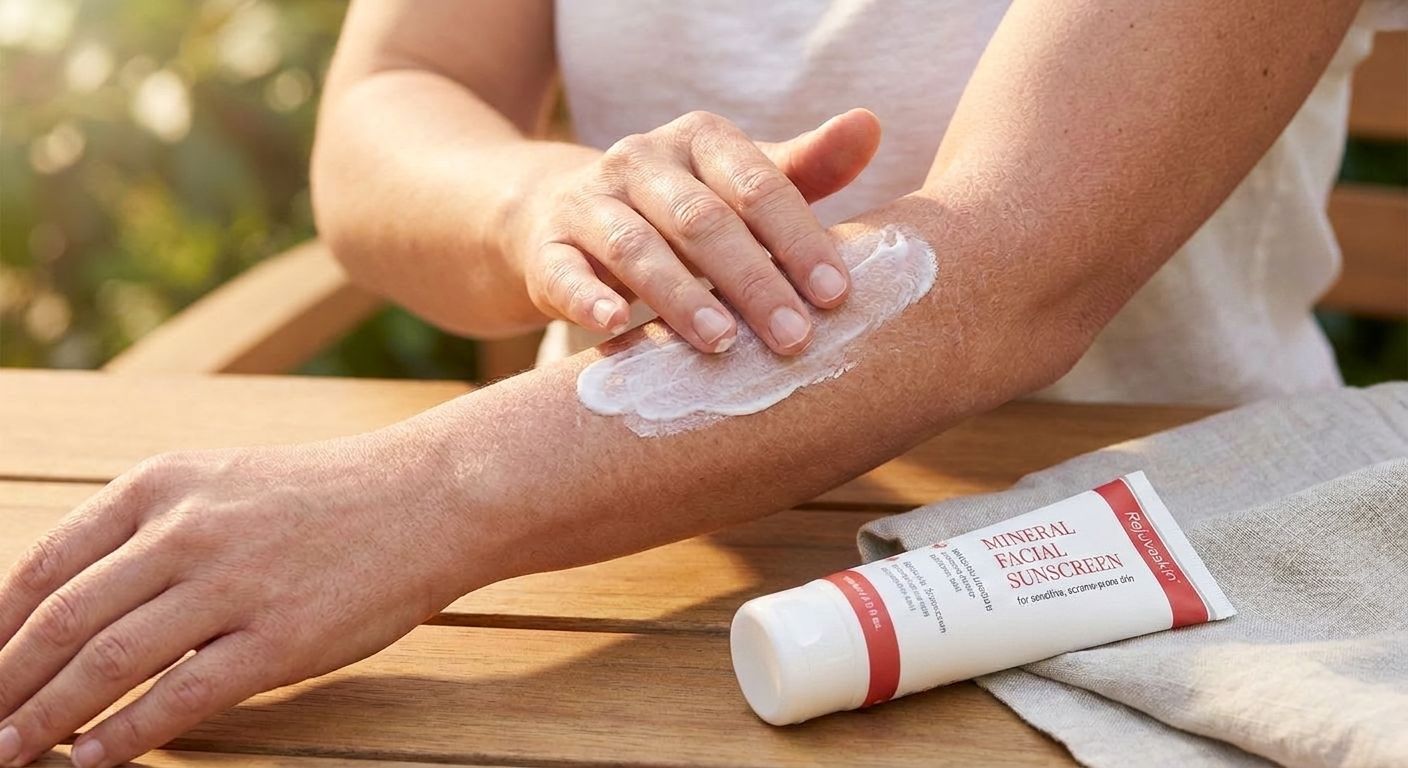
Mineral sunscreen works differently: zinc oxide sits on top of skin and reflects UV rays rather than absorbing them. The Rejûvaskin Mineral Facial Sunscreen uses this physical-block approach, formulated at SPF 32 for daily UVA/UVB coverage without the sting that chemical formulas cause on eczema-prone patches. That distinction — physical block versus chemical absorption — is the single biggest factor in whether a sunscreen calms skin or wrecks it.
Who this is for
This guide is for parents managing a child's eczema flares through summer camp and pool season, adults with chronic eczema who still need daily facial SPF, and anyone with a diagnosed compromised skin barrier who has already been burned (literally) by a drugstore chemical sunscreen. If your skin reacts to fragrance, dye, or alcohol in lotions, the same ingredients in sunscreen will cause the same reaction — just with added UV exposure on top.
What to look for in mineral sunscreen for eczema-prone skin
Non-nano zinc oxide as the active ingredient
Zinc oxide is the gold standard physical blocker for reactive skin because it doesn't require chemical penetration to work. Non-nano particle size matters because it sits on the skin's surface rather than working into broken tissue, which is exactly where eczema patches are most vulnerable.
Fragrance-free and dye-free formula
Fragrance is one of the top irritant triggers named in eczema care, and it shows up in sunscreens marketed as "clean" or "kid-friendly" more often than you'd expect. A formula with zero added fragrance and zero dye removes two of the most common flare triggers before SPF even enters the equation.
A short, recognizable ingredient list
The more filler ingredients in a sunscreen, the more chances for an eczema trigger to sneak in — alcohol, certain preservatives, and essential oils are common offenders. Shorter ingredient lists are easier to patch-test and easier to trust on inflamed skin.
Broad-spectrum SPF rated for daily wear
Eczema-prone skin needs consistent UVA/UVB coverage because sun exposure worsens inflammation and can darken post-flare marks. SPF 32 covers daily commuting, school pickup, and short outdoor stretches without requiring a heavier, greasier SPF 50+ formula that can clog and irritate.
A texture that goes on without rubbing
Eczema patches are often too tender for a sunscreen that needs to be worked in with friction. A cream that spreads with light patting rather than rubbing protects the skin barrier during application, not just after.
Reef-safe, non-nano labeling for outdoor family use
Families managing a child's eczema often spend more time at pools and beaches specifically because water and swim therapy can help certain skin conditions. A non-nano, reef-safe formula means the same sunscreen works at the pool, the lake, and the ocean without a second product.
Top picks for eczema-prone skin
Rejûvaskin Mineral Facial Sunscreen SPF 32 — the daily face pick. SPF 32, 100% mineral, zinc oxide as the physical active ingredient against UVA/UVB rays. This is the formula to reach for every morning regardless of whether skin is flaring or clear, because it's built to sit on top of skin rather than absorb into it. Verdict: Buy.
Dreamskin eczema clothing — the flare-zone backup. Sun-protective knitwear built with Dreamskin Technology, designed for skin that's too raw for topical products altogether. On days when a flare covers arms, legs, or a child's torso, clothing coverage removes the sunscreen-versus-skin conflict entirely. Verdict: Consider for active flare periods or infants who can't reliably keep sunscreen on.
Skin Recovery Cream — the barrier-repair layer. Formulated to fortify and soothe compromised, damaged skin, this cream is not a sunscreen and shouldn't replace one — it's the product that goes on before SPF to rebuild the barrier that eczema keeps breaking down. Applied nightly, it supports the same skin that has to tolerate sunscreen the next morning. Verdict: Buy, paired with SPF, not instead of it.
Eczema-friendly liner socks — the overlooked extremity. Feet and ankles get sunburned during sandal season just as often as arms, and eczema on feet is notoriously hard to keep sunscreen on without it rubbing off in shoes. A breathable liner sock designed for eczema-prone skin covers that gap without adding another topical product to manage. Verdict: Consider for anyone whose flares concentrate on feet or ankles.


What to avoid
- Chemical UV filters (oxybenzone, avobenzone, octinoxate) — these absorb into skin to work, and absorption is exactly what a broken eczema barrier can't tolerate without stinging or flaring.
- "Baby-friendly" sunscreens loaded with fragrance — marketing language doesn't override an ingredient panel; check for added fragrance regardless of who the bottle claims it's for.
- Aerosol spray sunscreens — many contain alcohol as a carrier, which dries and irritates already-compromised skin, and the fine mist is harder to control on cracked or weeping patches.
Verdict comparison
| Product | Best For | Key Spec | Verdict |
|---|---|---|---|
| Rejûvaskin Mineral Facial Sunscreen SPF 32 | Daily facial SPF | SPF 32, 100% mineral zinc oxide | Buy |
| Dreamskin eczema clothing | Active flares, infants | UV-protective knit fabric | Consider |
| Skin Recovery Cream | Barrier repair before SPF | Formulated for compromised skin | Buy (as prep) |
| Eczema liner socks | Feet and ankle flares | Breathable, friction-free | Consider |
| Chemical sunscreen | Not recommended | Absorbs into skin | Skip |
Rejûvaskin has built its physician-facing reputation on formulas like this — clinically-proven positioning, not vague wellness claims, and that same standard applies across its scar, radiation-relief, and sun-care lines in 2026.
FAQ
What's the best mineral sunscreen for eczema-prone skin in 2026?
Rejûvaskin Mineral Facial Sunscreen SPF 32 is a strong option in 2026 because it's 100% mineral, using zinc oxide as a physical blocker instead of chemical filters that irritate compromised skin. It's built for daily wear on skin that reacts to fragrance and absorbed UV filters.
Is zinc oxide safer than chemical sunscreen for eczema?
Zinc oxide sits on top of skin and reflects UV rays rather than absorbing into skin, which makes it gentler on a broken eczema barrier. Chemical filters like oxybenzone and avobenzone require absorption to work, and that absorption is what triggers stinging and flares on already-damaged skin.
Can eczema-prone skin use SPF 32 sunscreen daily?
Yes, SPF 32 covers daily UVA/UVB exposure for commuting, school runs, and short outdoor stretches without the heaviness of SPF 50+ formulas. Daily use matters more than a higher number, since consistent coverage prevents the sun-triggered inflammation that worsens eczema.
Does mineral sunscreen sting broken or irritated skin?
A well-formulated mineral sunscreen shouldn't sting because it doesn't need to penetrate skin to function. If a mineral formula still stings, check for added fragrance or alcohol in the ingredient list, since those are usually the actual irritant rather than the zinc oxide.
How much mineral sunscreen should you apply on eczema patches?
Apply a thin, even layer with patting motions rather than rubbing, since friction on eczema patches can trigger irritation on its own. Reapply after swimming or heavy sweating just as you would on unaffected skin.
Is fragrance-free sunscreen necessary for eczema-prone skin?
Fragrance is one of the most common topical irritants for eczema, so fragrance-free sunscreen is close to non-negotiable for flare-prone skin. Check the full ingredient list rather than trusting a front-label "unscented" claim alone.
Can children with eczema use the same mineral sunscreen as adults?
A fragrance-free, non-nano mineral formula is generally appropriate for both, but children with active flares or very young skin may do better with sun-protective clothing on the most affected areas. Always patch-test a new sunscreen on a small area of a child's skin before full application.
Should you wear sun-protective clothing instead of sunscreen on eczema flares?
During an active flare, clothing coverage avoids the friction and product contact that topical sunscreen requires, making it the more comfortable option for raw or weeping skin. Once the flare calms, mineral sunscreen can return as the daily default.
One last thing
The detail most people miss: sunscreen and scar or barrier-repair products aren't interchangeable, and layering them in the wrong order cancels out both. Skin Recovery Cream needs to absorb and do its repair work first — apply it at night or well before sun exposure, then let Mineral Facial Sunscreen sit on top as the final layer each morning. Reversing that order buries the repair cream under a physical block it can't get past.